
On this page
The tips below come from venue driver guides and Motorsport UK's own training material and racing rules: look ahead, keep your inputs smooth, use the whole width of the track, brake in a straight line and give other drivers room. The flag chart at the end shows what each flag looks like and what it means.
Before you get in
Listen to the briefing. Each venue explains its own signals, its rules on contact and what to do if you stop or spin, and what the briefing says overrides anything on this page. Club100 won't let drivers race if they miss its drivers' briefing. Get the seat and pedals right before you go out. Motorsport UK's training guidance for its youngest drivers asks for a bend in the legs with the pedals pressed fully down, which is a useful check at any age. If you can't reach comfortably, ask staff to adjust the seat or pedals.
Look ahead
Keep your eyes up and look through the corner to where you want the kart to go, rather than at the kart in front. Club100's driver guide makes looking ahead the driver's responsibility and asks racers to give the kart in front a bit of space in case it has a problem. Keep your hands on the wheel and your feet on the pedals whenever the kart is moving.
Smooth inputs
A kart changes direction quickly, so jerky steering and stabs at the pedals unsettle it. Turn in smoothly, squeeze the throttle on progressively and brake in a controlled way. If the kart starts to slide, ease off rather than adding more steering.
The racing line
Use the full width of the track: approach a corner from the outside, clip an apex on the inside and let the kart run back out to the edge on the exit. Instructors work from the same reference points. Motorsport UK's Bambino training guidelines tell them to mark the braking area, turn-in point and apex with cones. The ARKS test for new kart racers checks that you can lap safely and under control on the appropriate racing line, so it is the standard you'll be measured against if you go on to race.
The right line varies from corner to corner and track to track. Watch how the faster karts take each corner, and ask staff. The lap guides for Buckmore Park, Clay Pigeon Raceway and Daytona Milton Keynes go corner by corner.
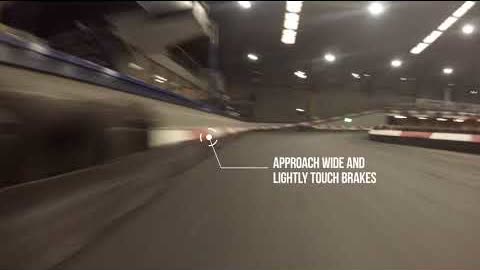 Play Understanding The Racing Line - 90 Degree Right-Hand | TeamSport (0:26)
Understanding The Racing Line - 90 Degree Right-Hand | TeamSport
TeamSport's own 26-second clip of one indoor corner, onboard and from above, with the line drawn on and each step labelled: approach wide, brake, turn in, apex, throttle on the exit.
Made by TeamSport Karting and hosted on YouTube; pressing play loads it from YouTube, which may set cookies. Checked .
Braking
Brake while the kart is travelling in a straight line, before you turn in, then come off the brake as you start to steer. Use one pedal at a time: Motorsport UK's Bambino guidance has instructors check that new drivers never use the pedals together, always one or the other. Brake early on your first laps and move the braking point later only as you gain confidence.
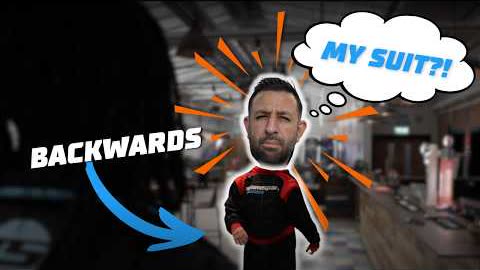 Play Mistakes BEGINNERS Make - Go Karting (2:19)
Mistakes BEGINNERS Make - Go Karting
TeamSport staff act out common first-session mistakes on one of their indoor tracks, including slamming the brake into a corner and spinning, then braking earlier, before the corner.
Made by TeamSport Karting and hosted on YouTube; pressing play loads it from YouTube, which may set cookies. Checked .
Overtaking and being overtaken
- Pass on a straight, or on the inside or outside of a corner when there's a clear gap, and leave the other driver room.
- Don't drive into someone to get past. Contact rules vary between venues, and the briefing covers them.
- If a faster kart catches you, hold your line and let it through where it's safe. That is what the blue flag is for (see below).
- If you spin or stop, do what the briefing told you. Club100 tells drivers not to try to fix a kart themselves and to tell a member of staff if something seems wrong.
Flags and signals
Many hire venues use flags, lights or both, and often a shorter set than the one below. These meanings come from Motorsport UK's karting rules for racing at licensed circuits (National Competition Rules 2026, Chapter 18, Appendix 5, Article 6).
| Flag | Meaning |
|---|---|
| Yellow, held still | Incident or hazard past the marshal post. Slow down enough to keep full control. No overtaking. |
| Yellow, waved | Great danger. Slow down considerably and be ready to leave the racing line or stop. No overtaking. |
| Yellow with red stripes | Slippery surface ahead. Waved means the slippery patch is close. |
| Green | Formation lap, or the end of a yellow-flag zone. |
| Green with yellow chevron | False start. |
| Blue, held still | Another driver is close behind you. |
| Blue, waved | Another driver is trying to overtake you. |
| Red | Racing stops. Return with caution to the grid or parc ferme as the marshals direct, with no overtaking, ready to stop at any time. |
| Black and white diagonal | A warning about your driving standards. It can lead to a penalty or a black flag. |
| Black, with your number | A breach of driving standards or a technical problem. Stop in the pits or parc ferme at the end of that lap and report to the Clerk of the Course straight away. |
| Black with orange disc, with your number | A mechanical problem with your kart. Drive straight to the pits or parc ferme for a scrutineer to examine it. |
| Black and white chequered | End of the session. |
If you see a flag you don't recognise, slow down and follow the marshals.
Sources
- Motorsport UK, National Competition Rules 2026, Chapter 18 Appendix 5 Article 6 (flag signals)
- Motorsport UK, ARKS, Bambino training guidelines
- Club100, Driver's Guide